
Trolonda Terrell, Certified Academic Language Therapist

Theory To Practice
Instructional Strategies to Enhance SEE
Practicum Competency 1.B
In addition to implementing the SEE Multisensory Language Approach, I implement other Multisensory instructional strategies that have proven to be effective in teaching students with learning differences. These strategies enhances the delivery of the SEE Program MSLE Curriculum.

01
TAKE FLIGHT PHONEME TILES
In order to strengthen phonemic awareness I instruct students with these movable color tiles to manipulate sounds by changing the initial, medial and ending sounds of words.
02
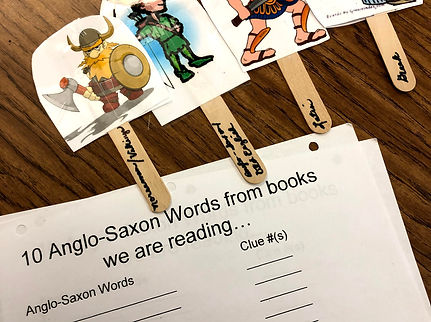
WORD DETECTIVE
Word Detective is taught for three weeks at Bridgemark. The students are presented with the story of word origins using the puppets. They literally become word detectives. I then review the learning throughout the year with this form. I use a form for Anglo-Saxon, Latin and Greek words.

03
SOUNDATIONS
I use instructional strategies from Soundations to aid in teaching phonemic awareness by using tiles to segment sounds in sentences and words. This instruction reinforces the alphabetic principle.
04
ELKONIN SOUND BOXES
I use the Elkonin sound boxes to segment sounds in words. The student says the word while touching the circle. The red box is the initial sound, and the blue box is the word family. The arrow is the repeat of the word going from left to right. The word can also be segmented using each sound or word only with left to right regression.


05
MONTESSORI LETTERS
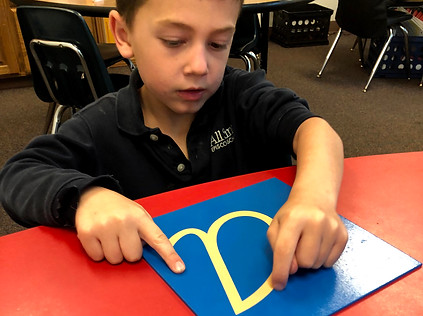
This a five year old boy I tutor as a beginning reader in Beginning Book I SEE. He enjoys the feel of the letters on the Montessori letter boards. Here he is learning to write the cursive capital A.
06
ALPHABET TILES
This student is participating in a "Making Words" activity, which involves rhyming, manipulating, segmenting words and building words to improve word recognition, spelling and phonemic awareness.

07
DECODABLE READERS
(Orton-Gillingham)
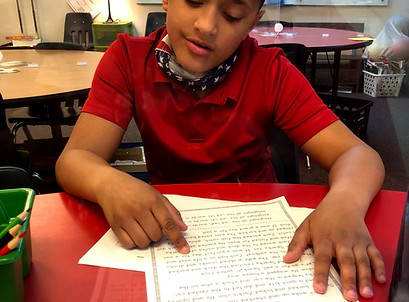
This student is completing a SEE lesson with a decodable reader that matched the "ed" words previously learned. I use Merrill readers and Orton-Gillingham approach readers to teach decoding in text.
08
PATTERNS FOR SUCCESS
This reading program was developed by Marcia Henry and Nancy Redding teaches phonics, vocabulary development, comprehension skills and fluency. There are three parts to this program:
Part 1: Letter-Sound Correspondences
Part 2: Syllable Patterns, Affixes, and Additional Phonics
Part 3: Morpheme Patterns


09
Six Syllable Types
The six syllable types are taught throughout the year to aid in word decoding.
10
Pencil Grips
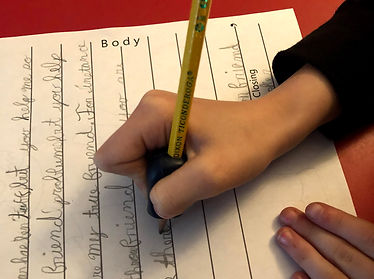
Students use pencil grips to enhance motor coordination, therefore improving cursive writing. Here is a third grader using the pencil grip while writing a friendly letter.

11
WHISPER PHONES
Whisper phones are used to assist students in reading by amplifying the sound, which helps kids more clearly hear the sounds and words they're saying. It helps them to concentrate on what they are reading. Some students need to hear themselves to assist in comprehension.
12
Smart Charts
Smart charts are reviewed and discussed on a regular bases to reinforce learning to mastery. We use smart charts for SEE, Language Arts, math, etc.
